SBI Pension Loan in India 2026: Interest Rate, Eligibility, Maximum Amount, EMI and How to Apply
Retirement can reduce regular income, but it does not remove the need for funds. A pensioner may need money for medical treatment, home repairs, a family expense, debt consolidation or another genuine personal requirement. The SBI Pension Loan in India is designed for eligible pensioners and family pensioners whose pension is credited through the State Bank of India.
Unlike a home loan or vehicle loan, a pension loan is generally an unsecured personal loan. The borrower ordinarily does not have to mortgage a house or pledge an investment. SBI instead examines the applicant’s pension, age, existing obligations, repayment capacity, account conduct and applicable scheme rules.
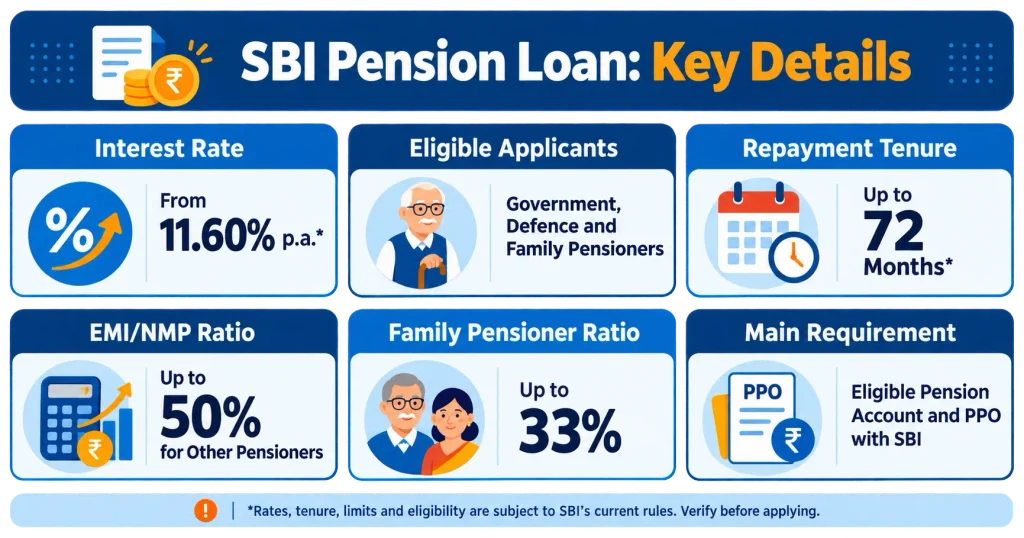
SBI’s official website displayed pension-loan pricing starting from 11.60% per annum when this guide was fact-checked on 2 September 2026. Rates and scheme conditions can change, so applicants should treat this as a starting rate—not a guaranteed personal offer—and verify the latest rate, fee and repayment schedule on SBI’s official website or at an SBI branch before signing.
Important: This is an independent educational guide, not an SBI website or loan offer. Approval, amount, rate and tenure are decided by SBI under the rules applicable on the date of application. Never pay an unknown agent or share an OTP, PIN, CVV or internet-banking password.
Table of Contents
SBI Pension Loan in India at a Glance
| Particular | General position |
|---|---|
| Loan type | Unsecured personal loan linked to pension income |
| Intended applicants | Eligible Central Government, State Government, defence and other approved pensioners; eligible family pensioners |
| Interest rate | Starting from 11.60% p.a. on SBI’s website when checked on 2 September 2026; the sanctioned rate may differ |
| Maximum loan | Determined by pension, age, pensioner category, existing EMIs and SBI’s current product ceiling |
| Regular maximum tenure | Commonly reported as up to 72 months, subject to age and scheme rules |
| Repayment-age condition | The loan usually must end within SBI’s prescribed maximum age; commonly reported as 78 years |
| EMI-to-pension limit | Commonly reported as up to 50% for pensioners and 33% for family pensioners |
| Security | Normally no tangible collateral; a guarantee or undertaking may be required in applicable cases |
| Pension account | Pension/PPO must generally be maintained with SBI or covered by the permitted pension-payment arrangement |
| End use | Personal needs, subject to the loan agreement and prohibited-use rules |
The table is a quick guide, not a sanction letter. Product ceilings and charges have changed over time, and different SBI pension-loan variants may have different conditions.
What Is an SBI Pension Loan in India?
An SBI Pension Loan in India is a personal loan offered against the regular pension received by an eligible retired person or family pensioner. “Against pension” does not mean that the borrower receives future pension in advance. It means SBI uses the pension as the principal recurring income for assessing how much EMI the applicant can reasonably repay.
After sanction and disbursement, the borrower repays the amount through fixed monthly instalments. The EMI normally includes both principal and interest. Because the pension account is maintained with SBI, the bank can assess pension credits and arrange monthly recovery from the account according to the signed mandate.
The loan can generally be used for legitimate personal requirements such as:
- medical or hospital expenses;
- repairs, renovation or accessibility improvements at home;
- family functions or urgent household expenses;
- education-related support for children or grandchildren;
- travel or purchase of household equipment; or
- consolidation of expensive debt, if the overall cost genuinely becomes lower.
A pension loan should not be treated as additional retirement income. It is borrowed money with interest, and every EMI reduces the pension available for food, medicines, utilities and emergencies.
Who Can Apply for an SBI Pension Loan in India?
Eligibility differs by pensioner category. The broad categories commonly covered are explained below.
Central and State Government pensioners
A retired Central or State Government employee may be considered when the pension is paid through SBI and the Pension Payment Order or relevant pension records are maintained under the bank’s permitted arrangement. The applicant must comply with SBI’s maximum age and repayment-age conditions.
The pensioner may also have to provide an irrevocable undertaking that the pension-payment mandate will not be transferred during the loan period without SBI’s permission or No Objection Certificate. Where the pension is routed through a treasury, SBI may require the relevant consent or confirmation.
Defence pensioners
Eligible defence pensioners may include retired personnel of the Army, Navy and Air Force, as well as specified paramilitary or armed police forces, Coast Guard, Rashtriya Rifles and Assam Rifles, subject to SBI’s current definitions.
Defence pensioners are commonly reported to have no minimum age bar under the scheme. However, the maximum age at application and the age by which repayment must finish still affect the available tenure and loan amount.
Family pensioners
A family pensioner is an authorised family member who receives a pension after the death of the original pensioner. SBI may lend to an eligible family pensioner, but the permissible EMI-to-net-monthly-pension ratio is generally more conservative. A commonly stated cap is 33% of net monthly pension, compared with up to 50% for other qualifying pensioners.
Treasury and PSU pensioners
Some pensioners receiving payments through a treasury or an eligible Public Sector Undertaking arrangement may be covered under a separate variant. Eligibility can depend on whether SBI has an acceptable pension-payment arrangement with the treasury, organisation or pension-disbursing authority. Such applicants should confirm their exact variant at the pension-paying branch.
Also, check Samsung Galaxy S27 Ultra Leaks
SBI Pension Loan Eligibility Criteria
An applicant should normally satisfy the following requirements:
- Regular eligible pension: The applicant must receive a qualifying pension or family pension.
- SBI pension relationship: The pension account and PPO or approved pension-payment arrangement should be maintained with SBI as required by the scheme.
- Age requirement: The applicant generally needs to be below the maximum age prescribed at processing. Older applicants may receive a shorter tenure because repayment must finish by the final permitted age.
- Adequate repayment capacity: The proposed EMI plus existing obligations must remain within the applicable pension-based ratio.
- Acceptable account and credit conduct: Delayed payments, overdues, write-offs or excessive outstanding debt can affect approval.
- Undertaking or mandate: The borrower may have to agree not to shift the pension arrangement without SBI’s NOC during the loan.
- Guarantee, where applicable: SBI may require a spouse eligible for family pension or another acceptable person to act as guarantor, depending on the category and current rules.
- Complete KYC and documentation: Identity, address, PAN and pension records should be valid and consistent.
Meeting these conditions does not create an automatic right to a loan. SBI can approve a smaller amount, offer a shorter tenure, request additional documents or decline the application after assessment.
SBI Pension Loan Age Limit
Age is especially important because it controls the possible repayment period. The scheme is commonly described as allowing applicants below 76 years at loan processing, with repayment completed by 78 years. Applicants must verify the precise rule applicable to their pension category and product variant.
For example, if the normal maximum tenure is 72 months but an applicant has only 30 months remaining before the prescribed final repayment age, the effective tenure may be restricted to 30 months. A shorter tenure produces a higher EMI for the same loan amount. Consequently, the amount that fits within the EMI-to-pension cap may fall sharply as the applicant approaches the upper age limit.
This is why “maximum tenure up to six years” does not mean every borrower will receive six years.
SBI Pension Loan Maximum Amount
There is no single maximum amount that every pensioner can borrow. Online sources have published different ceilings—including ₹14 lakh, ₹20 lakh and ₹25 lakh—because SBI has revised products over time and separate variants may apply. Quoting one old ceiling without a date or category can mislead readers.
The actual eligible amount is generally the lowest of:
- SBI’s current maximum product ceiling;
- the amount supported by the applicant’s net monthly pension;
- the amount that keeps the EMI within the applicable EMI/NMP ratio;
- the amount repayable within the age-limited tenure; and
- the amount SBI sanctions after reviewing existing debts, credit history and account conduct.
What does EMI/NMP ratio mean?
NMP means Net Monthly Pension—the pension available after applicable deductions. The EMI/NMP ratio measures how much of that pension would be consumed by the proposed EMI.
EMI/NMP ratio = Proposed monthly EMI ÷ Net monthly pension × 100
Suppose a pensioner receives a net pension of ₹50,000 per month. If the applicable cap is 50%, the total permissible monthly loan obligation may be up to ₹25,000, subject to SBI’s assessment. If the applicant already pays an EMI of ₹7,000, the room for the new loan may be only about ₹18,000—not ₹25,000.
For a family pensioner receiving ₹30,000 per month, a 33% cap works out to ₹9,900. Existing obligations can reduce the available capacity further.
These examples explain the ratio only; they do not guarantee eligibility.
SBI Pension Loan Interest Rate in 2026
SBI’s website showed pension-loan rates starting from 11.60% p.a. when checked on 2 September 2026. The bank’s separate personal-loan rate page stated that its two-year MCLR was 8.75% and its broader personal-loan rate range was 10.00% to 15.00% with effect from 30 June 2026. The rate sanctioned for a pension loan depends on the product’s pricing rules in force at that time.
The phrase “starting from” matters. It means 11.60% is not necessarily the rate every applicant will receive. Before accepting the loan, check:
- the annual interest rate stated in the sanction letter;
- whether it is fixed or linked to a benchmark and how resets work;
- the EMI and number of instalments;
- total interest over the full tenure;
- Annual Percentage Rate (APR), where provided;
- processing fee and GST;
- penal charges for delayed payment; and
- prepayment or foreclosure conditions.
Even a small rate difference matters over several years. Applicants should compare the total repayment, not merely the advertised starting rate.
SBI Pension Loan EMI Calculation
The standard reducing-balance EMI formula is:
EMI = P × r × (1 + r)^n ÷ [(1 + r)^n − 1]
Where:
- P is the loan principal;
- r is the monthly interest rate, or annual rate divided by 12 and then by 100; and
- n is the number of monthly instalments.
Illustrative EMI table at 11.60% p.a.
| Loan amount | Tenure | Approximate EMI | Approximate total interest |
|---|---|---|---|
| ₹3 lakh | 3 years | ₹9,905 | ₹56,580 |
| ₹5 lakh | 5 years | ₹11,018 | ₹1,61,080 |
| ₹10 lakh | 6 years | ₹19,320 | ₹3,91,040 |
| ₹15 lakh | 6 years | ₹28,980 | ₹5,86,560 |
| ₹20 lakh | 6 years | ₹38,640 | ₹7,82,080 |
The figures are rounded illustrations calculated at 11.60% on a monthly reducing balance. Actual EMI can differ due to the sanctioned rate, disbursement date, rounding, tenure, charges and SBI’s calculation method. Processing fees and other charges are not included.
How tenure changes the cost
A longer tenure usually reduces the EMI but increases total interest. A shorter tenure increases the monthly burden but may reduce the total cost. Pensioners should not automatically select the longest period. A sensible tenure leaves enough monthly pension for medicines, household expenses, insurance and unexpected costs.
Fees, Prepayment and Other Charges
Third-party pages currently show conflicting SBI Pension Loan processing fees—some quote 0.50% with a minimum fee, while others quote around 1% with minimum and maximum amounts. These figures may relate to different dates, campaigns or product variants. For that reason, this guide does not present either fee as universally current.
Ask the branch for a written charge sheet covering:
- processing fee and applicable GST;
- stamp duty or documentation charges, if applicable;
- legal or search-report expenses, if applicable;
- penal charges for delayed EMI payment;
- cheque or mandate-return charges;
- part-prepayment fee; and
- foreclosure fee and any stated exception.
Some published scheme descriptions mention a prepayment charge of 3% on the prepaid amount and an exemption when an existing pension loan is closed using proceeds of a new loan under the same scheme. This must be confirmed in the current sanction terms before repayment or refinancing.
Documents Required for SBI Pension Loan
SBI already holds much of an existing pension customer’s KYC and account information, so documentation may be simpler than for a new-to-bank borrower. Nevertheless, applicants should keep the following ready:
- completed and signed loan application form;
- recent passport-size photographs;
- Aadhaar or another officially valid identity document;
- PAN or Form 60, as applicable;
- current address proof;
- Pension Payment Order or e-PPO;
- pension account statement or passbook;
- recent pension slips or pension credit details;
- proof of date of birth;
- life certificate status, if requested;
- treasury or pension-disbursing authority documents, where relevant;
- signed undertaking regarding the pension-payment mandate;
- guarantor’s KYC and financial details, if a guarantee is required; and
- any additional document requested for the applicant’s category.
Names, dates of birth and addresses should match across documents. Resolve material discrepancies before applying, as inconsistencies can delay verification.
How to Apply for an SBI Pension Loan in India
Option 1: Apply through an SBI branch
The most dependable route—especially where a treasury consent, guarantor or record update is involved—is the SBI branch handling the pension account.
- Contact the pension-paying SBI branch.
- Ask for the current Pension Loan variant, interest rate, eligibility sheet and schedule of charges.
- Request an eligibility estimate based on net pension, age and existing EMIs.
- Complete the application form and submit the required documents.
- Read the sanction letter, Key Facts Statement and repayment schedule carefully.
- Sign only after checking the rate, EMI, tenure, total repayment, fees and prepayment rules.
- After documentation and approval, SBI credits the sanctioned amount to the eligible account.
Option 2: Check online or through SBI’s digital channels
Existing customers may be able to check an offer or begin an application through SBI’s official loan portal, internet banking or YONO, depending on eligibility and availability. A pre-approved offer is customer-specific and may have a separate amount or tenure. If the digital channel does not show an offer, it does not necessarily mean the person is ineligible; the pension-paying branch can assess a regular application.
Use only SBI’s verified domain or official app. Avoid sponsored pages that imitate bank branding, and never install a screen-sharing app at the request of a supposed loan agent.
How to Improve the Chances of Approval
- Check affordability first. Choose an amount whose EMI stays comfortably below the maximum permitted ratio.
- Reduce avoidable debt. Existing loan and card obligations consume repayment capacity.
- Maintain regular account conduct. Avoid unpaid dues, bounced mandates and unexplained irregular transactions.
- Review the credit report. Correct genuine errors before applying; do not pay anyone who promises to “erase” accurate defaults.
- Submit consistent documents. Matching KYC, PPO and account details reduce delays.
- Use the pension-paying branch. Staff there can identify the correct scheme and pension-disbursing arrangement.
- Do not make many simultaneous applications. Multiple hard enquiries can make the borrower appear credit-hungry.
No adviser or website can guarantee approval. The final decision belongs to SBI.
Advantages of an SBI Pension Loan
The product can be useful because it is designed around pension income, usually requires no tangible collateral and may involve simpler verification for an established SBI pension customer. It also provides a structured EMI schedule, which is easier to plan than revolving credit-card debt.
However, “easy documentation” should not be confused with “free money.” Interest and fees increase the total cost, and the EMI directly reduces monthly retirement cash flow.
Risks and Points to Consider Before Borrowing
Protect essential pension income
The bank’s maximum allowable EMI is a lending limit, not necessarily a safe personal budget. A household with high medical costs may need its EMI far below 50% of pension.
Keep an emergency buffer
Do not use every rupee of savings merely to avoid a slightly smaller loan. Pensioners should ideally retain accessible funds for medicines, repairs and family emergencies.
Avoid borrowing for speculation
Using a personal loan for shares, derivatives, cryptocurrency or an unverified high-return scheme can expose the borrower to both investment loss and fixed EMI liability.
Compare secured alternatives carefully
A loan against a fixed deposit or another secured facility may sometimes cost less, but it puts the underlying asset at risk or restricts access to it. Compare rate, charges, liquidity and consequences—not rate alone.
Beware of loan fraud
SBI will not need an OTP, ATM PIN, UPI PIN, CVV or internet-banking password to “release” a legitimate loan. Do not transfer an advance fee to a personal account. Confirm suspicious communication through the official SBI website or branch.
SBI Pension Loan vs Regular Personal Loan
| Point | SBI Pension Loan | Regular personal loan |
|---|---|---|
| Primary income considered | Pension or family pension | Salary, professional or business income |
| Main target group | Eligible pensioners | Eligible working or earning applicants |
| Account relationship | Pension-payment relationship is important | Salary/account relationship may help but varies |
| Tenure constraint | Strongly affected by maximum repayment age | Governed mainly by product tenure and borrower profile |
| EMI assessment | Linked closely to net monthly pension | Linked to net income and existing obligations |
| Documentation | May be lighter for existing pension customers | Income and employment records are generally required |
Neither option is automatically cheaper. Compare the actual sanctioned APR and total repayment.
Common Reasons an Application May Be Delayed or Declined
Possible reasons include an ineligible pension-payment arrangement, age leaving insufficient tenure, an EMI exceeding the permitted pension ratio, substantial existing debt, adverse repayment history, incomplete KYC, mismatch in PPO and account details, missing treasury consent, an unacceptable guarantor or failure to meet another current scheme condition.
A decline does not always mean the applicant can never qualify. The branch may explain whether a smaller amount, shorter request, corrected records or reduced obligations would make a fresh assessment possible. Avoid immediately applying through several lenders without first identifying the problem.
Frequently Asked Questions
What is the current SBI Pension Loan interest rate?
SBI’s official website showed pension-loan pricing starting from 11.60% per annum when checked on 2 September 2026. The final rate can differ and should be confirmed in the sanction letter.
What is the SBI Pension Loan maximum amount?
The eligible amount depends on SBI’s current product ceiling, the applicant’s pensioner category, net pension, age, available tenure, existing EMIs and credit assessment. Third-party sites show conflicting maximums, so confirm the current ceiling directly with SBI.
Is an SBI account required?
The pension and relevant PPO or approved pension-payment arrangement generally need to be maintained with SBI under the scheme. Ask the branch whether a transfer of pension relationship is possible before applying.
Can a family pensioner apply?
Yes, an eligible authorised family pensioner may apply, subject to SBI’s age, documentation and repayment-capacity rules. The commonly reported EMI/NMP cap for family pensioners is 33%.
Is collateral required?
An SBI Pension Loan is generally an unsecured personal loan, so tangible collateral is normally not required. SBI may nevertheless require an undertaking, repayment mandate or guarantee depending on the category.
What is the maximum repayment tenure?
The regular scheme is commonly reported with a tenure of up to 72 months. The actual tenure may be shorter because the loan must finish within the prescribed maximum repayment age. Digital or pre-approved variants may have different tenures.
Can an SBI Pension Loan be prepaid?
Prepayment may be allowed, but a charge and exceptions may apply. Obtain the current foreclosure statement and written charge rule from SBI before paying.
How can I check my application status?
Use the reference number through SBI’s official loan-status facility, contact the pension-paying branch or use an official SBI digital channel. Do not enter account credentials on a third-party status page.
How can I obtain an SBI Pension Loan statement?
Loan-account details may be available through SBI internet banking, YONO or the servicing branch. Availability depends on how the loan account is linked to the customer’s digital profile.
Does a high credit score guarantee approval?
No. Credit history can influence the decision, but age, pension, existing obligations, pension-payment arrangement and scheme conditions also matter.
Is it wise to take the maximum eligible amount?
Not necessarily. Borrow only what is needed and choose an EMI that leaves enough pension for regular living costs, healthcare and emergencies.
Final Verdict
The SBI Pension Loan in India can provide convenient, collateral-free funding to an eligible SBI pensioner or family pensioner. Its usefulness depends less on the advertised maximum and more on the applicant’s actual pension, age-limited tenure, EMI capacity and total borrowing cost.
Before applying, calculate an affordable EMI, verify the latest rate and fees from SBI, compare alternatives, and read the sanction letter and Key Facts Statement. The safest loan is not the largest amount the bank permits; it is the smallest amount that solves the need without putting essential retirement income under pressure.
Sources
- SBI Pension Loans: https://sbi.bank.in/web/personal-banking/pension-loans
- SBI Personal Loan Interest Rates: https://sbi.bank.in/web/interest-rates/interest-rates/loan-schemes-interest-rates/personal-loans-schemes
- RBI Financial Education: https://www.rbi.org.in/FinancialEducation/
2 Comments