Emergency Fund Calculator For Indian Families
The Emergency Fund Calculator For Indian Families helps you estimate how much money your household should save for unexpected situations. It considers your essential monthly expenses and the number of months for which you need financial protection.
An emergency fund can support your family during a job loss, medical emergency or temporary business problem. It can also cover urgent home and vehicle repairs.
Without emergency savings, you may have to use a credit card or personal loan. You might also have to sell investments at the wrong time.
Most Indian families should save between 3 and 12 months of essential expenses. The correct amount depends on your income stability, family structure, dependants, EMIs and insurance coverage.
Table of Contents
How Does the Emergency Fund Calculator For Indian Families Work?
The basic calculation is simple:
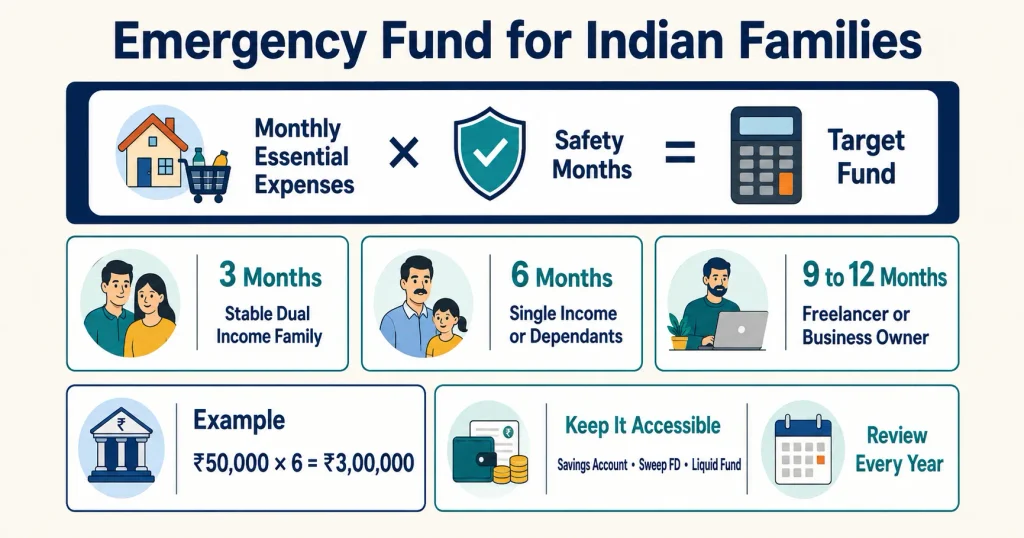
Emergency Fund Target = Essential Monthly Expenses × Required Number of Months
You can also add a separate medical reserve if your insurance coverage is limited.
To calculate your target, enter:
- Your essential monthly expenses
- Your mandatory loan EMIs
- Your current emergency savings
- Your required safety period
- The number of months available to build the fund
The calculator can then estimate your total target, existing coverage, remaining gap and required monthly contribution.
Emergency Fund Calculation Example
Suppose your family spends ₹50,000 every month on essential needs.
You want a six month financial buffer.
Your calculation will be:
₹50,000 × 6 = ₹3,00,000
Therefore, your emergency fund target is ₹3 lakh.
Suppose you already have ₹1 lakh in emergency savings.
Your remaining gap will be:
₹3,00,000 minus ₹1,00,000 = ₹2,00,000
You want to complete this amount in ten months.
Your required monthly contribution will be:
₹2,00,000 ÷ 10 = ₹20,000
You must save ₹20,000 per month for the next ten months.
The Emergency Fund Calculator For Indian Families uses this method to provide a clear savings target. It does not depend on uncertain investment returns.
Quick Emergency Fund Estimates
The following table shows how much you may need at different monthly expense levels.
| Essential Monthly Expenses | 3 Month Fund | 6 Month Fund | 9 Month Fund | 12 Month Fund |
|---|---|---|---|---|
| ₹20,000 | ₹60,000 | ₹1,20,000 | ₹1,80,000 | ₹2,40,000 |
| ₹30,000 | ₹90,000 | ₹1,80,000 | ₹2,70,000 | ₹3,60,000 |
| ₹40,000 | ₹1,20,000 | ₹2,40,000 | ₹3,60,000 | ₹4,80,000 |
| ₹50,000 | ₹1,50,000 | ₹3,00,000 | ₹4,50,000 | ₹6,00,000 |
| ₹75,000 | ₹2,25,000 | ₹4,50,000 | ₹6,75,000 | ₹9,00,000 |
| ₹1,00,000 | ₹3,00,000 | ₹6,00,000 | ₹9,00,000 | ₹12,00,000 |
These figures are general estimates. Your family may need a higher target if you have irregular income, several dependants or major medical responsibilities.
What Is an Emergency Fund?
An emergency fund is money reserved for necessary and unexpected expenses.
It is not meant for vacations, shopping or planned celebrations. It should not be used for a new phone, vehicle upgrade or regular festival expenses.
The main purpose of this fund is financial protection. The money should remain safe and easy to access.
SEBI encourages people to allocate money for unexpected expenses and financial setbacks. It also advises households to prepare a budget and prioritise essential needs. You can read this information on the SEBI Investor Education website.
An emergency fund can help during:
- Job loss
- Salary delays
- Medical emergencies
- Temporary business losses
- Reduced freelance work
- Urgent home repairs
- Essential vehicle repairs
- Unexpected emergency travel
How Many Months of Expenses Do You Need?
There is no single target for every Indian family.
A dual income couple may need a smaller fund than a family that depends on one salary. A freelancer may need more savings than someone with a stable job.
Three Months of Expenses
A three month fund may be suitable for a dual income household with stable jobs.
Both earners should preferably work for different employers. The family should also have suitable health insurance and limited debt.
Three months should normally be treated as a minimum starting point.
Six Months of Expenses
A six month fund may be suitable for a single income household.
It can also be appropriate for families with children, regular EMIs or private sector employment.
Six months is a practical target for many salaried Indian families.
Nine Months of Expenses
A nine month fund may be suitable if your employment is less secure.
It can also help families with elderly dependants, high EMIs or limited insurance.
Consider nine months if both spouses work for the same employer or industry. One business problem could affect both incomes.
Twelve Months of Expenses
A twelve month fund may be appropriate for freelancers, consultants and business owners.
Their income can change every month. Payments may also be delayed.
A larger reserve provides more time to recover without taking expensive debt.
What Expenses Should You Include?
The Emergency Fund Calculator For Indian Families should use essential household expenses. It should not use your complete salary.
Include the following costs:
- Rent or home loan EMI
- Basic groceries
- Electricity and water bills
- Cooking gas
- Essential mobile and internet services
- School fees
- Insurance premiums
- Regular medicines
- Essential transport costs
- Vehicle and education loan EMIs
- Necessary household support
Convert annual costs into monthly amounts.
Suppose your annual health insurance premium is ₹24,000.
₹24,000 ÷ 12 = ₹2,000 per month
Add ₹2,000 to your monthly essential expenses.
Avoid counting the same expense twice. If your home loan EMI is already included under housing costs, do not enter it again.
Which Expenses Should You Exclude?
Exclude expenses that can be reduced or stopped during a serious financial problem.
These may include:
- Restaurant meals
- Holidays
- Entertainment subscriptions
- Luxury purchases
- Optional memberships
- Festival shopping
- Mobile phone upgrades
- Long term investment contributions
A planned expense is not an emergency.
Annual school admission fees, vehicle servicing and insurance renewals are usually predictable. You can create separate savings funds for these expenses.
Should You Add a Medical Reserve?
Health insurance may not cover every medical cost. You may face deductibles, exclusions or expenses that require immediate payment.
Families with elderly dependants may need a separate medical reserve.
Use this formula:
Total Emergency Fund = Monthly Essential Expenses × Required Months + Medical Reserve
Suppose your family spends ₹45,000 per month. You want nine months of protection. You also want a ₹1 lakh medical reserve.
₹45,000 × 9 = ₹4,05,000
₹4,05,000 + ₹1,00,000 = ₹5,05,000
Your total emergency fund target will be ₹5.05 lakh.
A medical reserve should support your health insurance. It should not replace suitable insurance coverage.
How to Calculate Your Current Coverage
Your current coverage shows how many months your existing savings can support your family.
Use this formula:
Current Coverage = Available Emergency Savings ÷ Essential Monthly Expenses
Suppose you have ₹1,80,000 saved.
Your essential expenses are ₹45,000 per month.
₹1,80,000 ÷ ₹45,000 = 4 months
Your current emergency savings can support your family for approximately four months.
Count only money that can be accessed easily. Do not include your home, jewellery or retirement investments.
How to Build Your Emergency Fund
A large target can appear difficult. Build it in smaller stages.
Start with one month of essential expenses. This amount can cover smaller emergencies.
Your next target should be three months. After that, continue until you reach six, nine or twelve months.
Set up an automatic transfer after receiving your salary. Keep the amount realistic.
You can also use part of your bonus, tax refund or freelance income. These payments can help you reach the target sooner.
Keep the money separate from your regular spending account. This makes your progress easier to track. It also reduces accidental spending.
Where to Keep an Emergency Fund in India
Safety and accessibility are more important than high returns.
Your family should be able to access the money without waiting for favourable market conditions.
Savings Account
Keep enough money for immediate needs in a savings account.
You may keep one month of essential expenses here. It can be accessed through an ATM, UPI or bank transfer.
Eligible deposits are insured according to DICGC rules. The current insurance limit is ₹5 lakh per depositor per bank. This includes principal and interest held in the same capacity and right. Read the official DICGC Deposit Insurance Guide.
Sweep In Fixed Deposit
A sweep in fixed deposit is linked to your savings account.
When your account balance becomes low, the bank may automatically transfer money from the deposit.
Check the bank’s withdrawal rules, minimum amount and possible interest reduction before using this option.
Liquid Mutual Fund
A liquid mutual fund invests in short maturity instruments. AMFI explains that liquid funds invest in securities with maturities of up to 91 days. Read the AMFI Fund Categorisation Guide.
Liquid funds may provide convenient access. However, they are not bank deposits. Their returns and capital are not guaranteed.
Check the risk level, portfolio quality, exit load and redemption rules before investing.
Where Should You Not Keep It?
Avoid keeping emergency savings in assets that are volatile or difficult to sell.
These include:
- Equity shares
- Equity mutual funds
- Cryptocurrency
- Real estate
- Gold jewellery
- Locked investment products
- Retirement accounts
A credit card is also not an emergency fund. It is borrowed money. You may have to repay it with high interest.
When Should You Review Your Target?
Use the Emergency Fund Calculator For Indian Families at least once every year.
You should also recalculate after:
- Marriage
- The birth of a child
- A job change
- A new loan
- A large salary change
- Increased school fees
- A change in insurance
- Moving to another city
- Becoming self employed
- Using part of the fund
Your monthly expenses may increase because of inflation. Your emergency fund should increase accordingly.
Also, check SBI Pension Loan in India 2026
Common Emergency Fund Mistakes
One common mistake is using total income instead of essential expenses.
Another mistake is forgetting loan EMIs. These payments may continue even when your income stops.
Some people count shares, property and jewellery as emergency savings. These assets may not be available immediately.
Chasing high returns is another serious mistake. An emergency fund is created for safety and liquidity. It is not created for maximum growth.
You should also refill the fund after using it. Restart your regular contributions when your income becomes stable.
Frequently Asked Questions
How much emergency fund should an Indian family have?
Most families should consider 3 to 12 months of essential expenses. The target depends on income stability, dependants, insurance and debt.
Is six months of emergency savings enough?
Six months may be enough for a salaried household with stable income. Freelancers and business owners may need 9 to 12 months.
Should I include EMIs?
Yes. Include all mandatory loan payments. Do not count the same EMI twice.
Can I keep my emergency fund in a fixed deposit?
Yes. Check the premature withdrawal rules and possible penalties. A sweep in facility may provide easier access.
Is a liquid mutual fund completely safe?
No mutual fund is completely risk free. Liquid funds may carry credit, interest rate and liquidity risks.
Is the Emergency Fund Calculator For Indian Families accurate?
The calculator provides an estimate based on the information you enter. Your actual requirement may differ because of health needs, dependants, income risk and personal circumstances.
Final Thoughts
The Emergency Fund Calculator For Indian Families gives you a practical starting point for financial protection.
Calculate your essential monthly expenses. Choose a suitable protection period. Subtract the savings you already have. Divide the remaining gap into affordable monthly contributions.
Keep the money safe and accessible. Review your target every year. Refill the fund after every withdrawal.
Even a small emergency reserve is better than having no protection. Start with one month of essential expenses. Build the remaining amount gradually.

One Comment