Laptop Prices May Increase by 5-10% in Q4 2026: Should You Buy Now or Wait?
Laptop prices may increase by 5-10% in Q4 2026. This expected increase could affect laptops, desktop computers and tablets in India.
The warning comes at an important time. Many students, professionals and gamers plan their purchases around major festival sales. Some buyers may now wonder if they should purchase a laptop immediately or wait for a better deal.
The expected increase is mainly linked to the rising cost of memory chips. These components are essential for almost every modern computer. They include the memory used in RAM and SSD storage.
Strong demand from artificial intelligence data centres is putting additional pressure on the global memory supply. Manufacturers are also prioritising advanced memory products used in servers. This leaves less production capacity for consumer electronics.
However, the expected 5-10% increase does not mean every laptop will become more expensive by the same amount. The final impact will depend on the brand, model, existing inventory and available discounts.
Here is what laptop buyers need to know before making a decision.
Table of Contents
Why Laptop Prices May Increase by 5-10% in Q4 2026
The main reason behind the expected laptop price increase is the growing cost of memory chips.
According to Arnold Su, Vice President for the Consumer and Gaming PC segment at ASUS India, memory chips now represent nearly 50% of the total cost of certain devices. Their share was reportedly around 10% to 15% about two years ago.
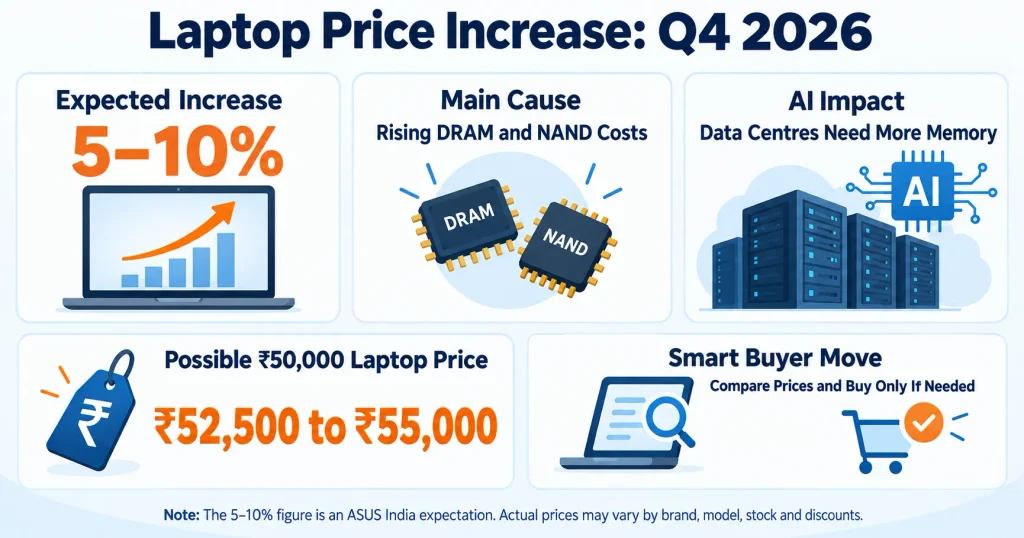
ASUS India expects device prices to increase by another 5% to 10% during the October to December quarter of 2026. This estimate covers products such as laptops, personal computers and tablets.
The company had already increased some prices earlier in 2026. The latest warning suggests that the pressure on manufacturers has not ended.
The original comments were reported by Business Standard.
This is an industry expectation from one major manufacturer. It is not an official government announcement. It is also not a compulsory increase that every laptop brand must follow.
What Memory Chips Are Used in a Laptop?
A modern laptop depends on different types of memory.
RAM provides temporary working space for the operating system and applications. A laptop with more RAM can usually handle more programs at the same time.
An SSD provides permanent storage. It stores Windows, applications, games, documents, photos and videos. SSDs use NAND flash memory.
A gaming laptop may also have dedicated video memory. This is commonly called VRAM. It is installed with the graphics processor and helps manage visual data.
Higher prices for DRAM and NAND can therefore affect several parts of a laptop. Models with 16GB or 32GB RAM may face more cost pressure than basic configurations. Laptops with 1TB or 2TB SSDs can also become more expensive to manufacture.
How Is Artificial Intelligence Affecting Laptop Prices?
Artificial intelligence is not directly increasing the price written on a laptop box. Its impact is happening through the global semiconductor supply chain.
Large AI data centres require enormous amounts of computing power. They also need high capacity server memory and high bandwidth memory.
Memory manufacturers have limited production capacity. Producing more advanced and profitable memory for AI servers can reduce the capacity available for conventional consumer memory.
This creates competition for production resources.
The International Data Corporation reported that major memory manufacturers have shifted more attention towards products used in AI data centres. It also warned that restricted DRAM and NAND supply could affect PC prices and specifications.
TrendForce forecast that conventional DRAM contract prices could rise by 13% to 18% during the third quarter of 2026. It also expected NAND Flash contract prices to increase by 10% to 15% during that quarter.
These component increases do not pass directly to shoppers at the same percentage. Laptop manufacturers may absorb part of the cost. They may also adjust specifications, reduce discounts or increase the final retail price.
How Much More Could You Pay?
A 5% increase may appear small. However, it can become significant on an expensive laptop.
The following examples show the possible difference.
| Current Laptop Price | Price After 5% Increase | Price After 10% Increase |
|---|---|---|
| ₹30,000 | ₹31,500 | ₹33,000 |
| ₹40,000 | ₹42,000 | ₹44,000 |
| ₹50,000 | ₹52,500 | ₹55,000 |
| ₹60,000 | ₹63,000 | ₹66,000 |
| ₹80,000 | ₹84,000 | ₹88,000 |
| ₹1,00,000 | ₹1,05,000 | ₹1,10,000 |
These figures are simple calculations. They are not price predictions for specific models.
A laptop currently available for ₹50,000 could theoretically cost ₹52,500 after a 5% increase. It could reach ₹55,000 after a 10% increase.
The real change may be smaller or larger. Some models may not receive an increase at all.
Will Every Laptop Become More Expensive?
No. Laptop pricing is more complicated than applying one percentage to every product.
Brands may have existing inventory that was manufactured before the latest memory cost increase. Retailers may also hold older stock purchased at lower wholesale prices.
Premium brands may be able to absorb part of the additional cost. Budget models usually have smaller profit margins. Manufacturers have less room to absorb higher component costs in this category.
A brand can respond to higher costs in several ways. It can increase the retail price. It can reduce discounts. It can introduce a lower specification. It can also replace a model with a newer and more expensive version.
This means the effect may not always appear as a direct price increase. A new laptop may launch at the same price but offer less RAM or storage than expected.
Buyers should therefore compare specifications as carefully as prices.
Could Budget Laptops Be Affected More?
Budget laptops are particularly sensitive to component cost changes.
A person buying a ₹35,000 laptop may have a strict spending limit. An increase of ₹3,000 can move a suitable model outside that budget.
Manufacturers also have limited margins on affordable devices. They may find it difficult to include 16GB RAM and a large SSD without raising the price.
This could result in more laptops being sold with 8GB RAM or smaller SSDs. Buyers may then need to spend additional money on upgrades.
Students should be especially careful. A very cheap laptop may save money initially but become difficult to use after a few years.
The processor, RAM, SSD and upgrade options should all be checked before making a purchase.
Will Gaming Laptops and PCs Become More Expensive?
Gaming laptops may also be affected.
These machines usually include more RAM and storage than basic office laptops. Many models have 16GB or 32GB RAM. They may also include a 1TB SSD and dedicated graphics memory.
Gaming PC builders could face a similar problem. A complete gaming computer needs system memory and storage. The graphics card also includes its own memory.
However, every component follows a different pricing cycle. A higher RAM price does not guarantee that graphics cards or processors will increase at the same time.
Desktop PC buyers have one advantage. Individual components can be upgraded later. A person can start with 16GB RAM and add more memory when required.
Laptop buyers often have fewer upgrade choices. Some thin laptops have soldered RAM that cannot be replaced.
Should You Buy a Laptop Before Q4 2026?
You should consider buying before Q4 if you already need a laptop.
For example, your current laptop may be damaged or unable to run essential software. You may also need a computer for college, remote work, programming or professional editing.
In these situations, delaying the purchase solely to find a slightly better discount may not be worthwhile. A genuine deal on a suitable model can be a good opportunity.
However, do not purchase the first laptop you see.
Choose two or three models that match your requirements. Record their regular prices. Compare prices across official brand stores and established retailers.
This will help you recognise a real discount. Some websites display a high crossed out price to make an ordinary selling price appear special.
When Should You Wait?
Waiting is sensible if your current laptop works properly and you do not have an urgent requirement.
A possible future price increase is not a reason to spend ₹50,000 today. Technology products continue to improve. New processors and updated laptop designs will keep entering the market.
Older models may also receive discounts when a new generation arrives.
The correct decision depends on your need. It should not depend on fear.
If you planned to upgrade six months later, continue saving money. Monitor the models you like. Purchase only when the upgrade provides a clear benefit.
What Specifications Should You Choose?
The right specifications depend on how you plan to use the laptop.
RAM
For web browsing, online classes and basic office work, 8GB RAM may still be usable. However, 16GB provides a more comfortable experience for multitasking.
Video editors, programmers and serious gamers may need 16GB or 32GB. Check whether the RAM is upgradeable before purchasing.
SSD Storage
A 512GB SSD is a practical starting point for many users. A 256GB SSD can become full quickly after installing Windows, applications and personal files.
Content creators and gamers may require 1TB or more.
Processor
Do not judge a processor by the Intel Core or AMD Ryzen label alone. Check its complete model number and generation.
A newer entry level processor is not always faster than an older performance focused processor.
Display
Check the display resolution, brightness and colour quality. Full HD resolution is suitable for most users.
Creators should look for better colour coverage. People who work outdoors or near bright windows should prioritise higher brightness.
Battery and Build Quality
Battery capacity alone does not reveal real battery life. Processor efficiency, display brightness and software optimisation also matter.
Look for reliable reviews that test everyday battery performance.
Upgradeability
An upgradeable laptop can offer better long term value. Check whether the RAM and SSD can be replaced.
Some manufacturers provide one free memory slot. Others solder all the memory to the motherboard.
Are Festival Sales Still Worth Waiting For?
Major sales can still offer useful discounts. Retailers may reduce prices to clear existing stock. Banks may also provide instant discounts or cashback offers.
However, a sale discount does not always cancel a market wide price increase.
A laptop priced at ₹50,000 today could move to ₹55,000 before a sale. A later discount of ₹4,000 would bring it to ₹51,000. The customer would still pay more than the earlier regular price.
Track the actual selling price before the sale begins. Browser price history tools can also help identify artificial discounts.
Read the bank offer terms carefully. Some discounts require a specific credit card, minimum purchase value or EMI plan.
Can Laptop Prices Fall Again in 2027?
Laptop prices could stabilise or fall if memory supply improves. However, a clear timeline is not available.
New manufacturing capacity takes time to build. Demand from AI data centres also remains strong.
Market conditions can still change. Consumer demand may weaken. Manufacturers may increase production. Competition among laptop brands may also limit price increases.
It would therefore be inaccurate to claim that laptop prices will definitely remain high throughout 2027.
Buyers should make decisions using present needs and verified prices. They should not rely on uncertain predictions about the distant future.
Smart Laptop Buying Checklist
Before paying for a laptop, complete these checks.
- Decide the maximum amount you can spend.
- Identify the programs you need to run.
- Compare at least three suitable models.
- Check the complete processor model number.
- Prefer 16GB RAM if your budget allows it.
- Check whether the RAM can be upgraded.
- Choose enough SSD storage for future use.
- Read independent reviews about heating and battery life.
- Confirm the warranty and service centre availability.
- Compare the final price after bank offers and delivery charges.
These steps are more valuable than buying quickly because of a headline.
Frequently Asked Questions
Are laptop prices expected to increase in Q4 2026?
ASUS India expects laptop, PC and tablet prices to increase by another 5% to 10% during the October to December quarter of 2026. This is an expectation and not a fixed increase for every device.
Why are laptop prices increasing in 2026?
Higher DRAM and NAND costs are increasing manufacturing expenses. Strong demand from AI data centres is also placing pressure on the global memory supply.
Will all laptop brands increase their prices?
Not necessarily. Each brand has different costs, inventory and pricing strategies. Some may raise prices. Others may reduce discounts or change product specifications.
Should students buy a laptop now?
Students who need a laptop for classes should begin comparing models now. Buying before Q4 may make sense if a suitable laptop is available at a genuine discount.
Will budget laptops become expensive?
Budget laptops may face greater pressure because they have smaller profit margins. Brands could increase prices or offer less RAM and storage at existing price points.
Is 16GB RAM enough in 2026?
Yes. 16GB RAM is suitable for office work, study, general programming and moderate gaming. Professional editing and advanced workloads may require more.
Should I wait for a festival sale?
You can wait if a major sale is close. However, track the current price first. This will help you determine whether the sale price offers a genuine saving.
Is the 5-10% laptop price increase confirmed?
No. It is an expectation shared by an ASUS India executive. The actual increase will depend on the manufacturer, model, inventory and market conditions.
Also, check Redmi Note 17 Pro Max India Launch
Final Verdict
Laptop prices may increase by 5-10% in Q4 2026 because memory costs remain high. ASUS India expects another increase during the October to December quarter.
The pressure comes from rising DRAM and NAND costs. Strong AI server demand is one important factor. Memory manufacturers are giving more capacity to advanced data centre products. This affects the supply available for consumer devices.
Still, the expected increase will not be identical for every laptop. Existing stock, competition and seasonal discounts can produce different results.
Buy now if you genuinely need a laptop and find the correct specifications at a fair price. Start tracking prices before Q4 begins.
Wait if your current laptop works properly and the upgrade is optional. Do not make an unnecessary purchase because prices may rise.
The smartest approach is simple. Set your budget. Select two or three suitable models. Track their real prices. Buy when a good offer matches your actual requirements.





One Comment